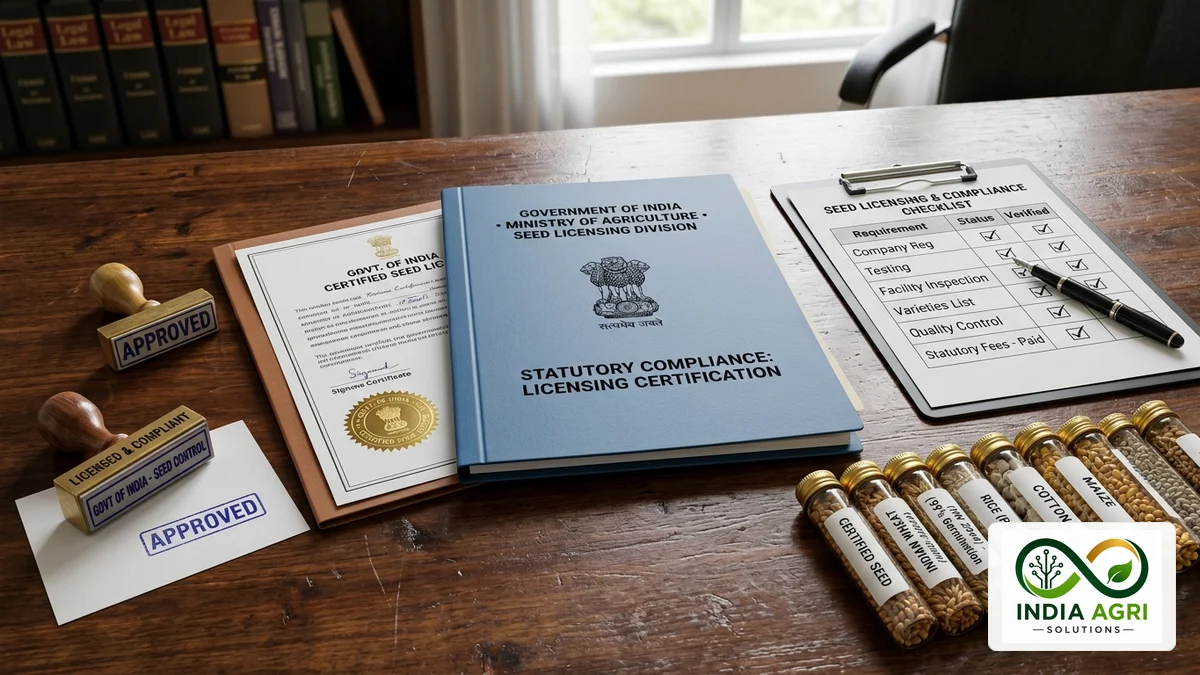
Statutory Distinction: Seed Certification vs Seed Licensing
In the Indian agricultural regulatory framework, Seed Licensing and Seed Certification represent two fundamentally distinct legal concepts administered by separate statutory authorities under different legislative instruments. While both mechanisms exist to protect farmers and maintain crop quality standards, confusing the two frequently causes regulatory non-compliance, supply chain delays, and legal liabilities.
In summary: Seed Licensing is a mandatory statutory permit required by every entity engaged in commercial seed production, stocking, or sale under the Seed Control Order, 1983. Conversely, Seed Certification is a legally voluntary quality assurance process governed by Section 8 and Section 9 of the Seeds Act, 1966, designed to verify varietal genetic purity through multi-generation pedigree control.
Detailed Regulatory Comparison Matrix
| Regulatory Parameter | Seed Licensing | Seed Certification |
|---|---|---|
| Governing Legislation | Seed Control Order, 1983 (promulgated under Section 3 of the Essential Commodities Act, 1955). | Seeds Act, 1966 (Sections 8, 9, 10) and the Seeds Rules, 1968. |
| Legal Nature | Strictly Mandatory: No commercial business can produce, stock, or distribute seeds without a valid Form B license. | Legally Voluntary: Seed enterprises can choose to market seeds as "Truthfully Labelled (T/L)" without formal certification. |
| Notified Administrative Authority | State Department of Agriculture (District Agricultural Officer / Joint Director of Agriculture). | State Seed Certification Agency (SSCA) established under Section 8 of the Seeds Act. |
| Regulatory Focus | Verifies facility infrastructure, godown storage conditions, Form O source authenticity, and business legitimacy. | Enforces genetic trueness-to-type, field isolation distances, roguing purity, and laboratory germination standards. |
| Official Labeling & Tag Colors | Truthfully Labelled (T/L) commercial seeds carry a standard Opal Green Tag with manufacturer declarations. | Certified seeds carry an official government Azure Blue Tag; Foundation seeds carry a statutory White Tag. |
Truthfully Labelled (T/L) Seeds vs Certified Seeds
The vast majority of proprietary commercial hybrid seeds in India—including hybrid cotton, hybrid maize, hybrid bajra, and vegetable cultivars—are marketed under the Truthfully Labelled (T/L) Seed framework rather than government certification:
- Truthfully Labelled (T/L) Seed Framework: The seed producing company assumes sole legal responsibility for the genetic purity, physical purity, and germination percentages declared on the container. The seed must strictly meet the minimum notification standards prescribed under Section 6 of the Seeds Act, but is not subject to field inspections by the State Seed Certification Agency.
- Certified Seed Framework: Requires advance registration of seed production plots with the SSCA, mandatory multi-stage field inspections by government Seed Certification Officers during vegetative, flowering, and harvesting phases, followed by statutory seed lot sampling and laboratory testing before official Azure Blue certification tags are released.
Penal Sanctions for Unlicensed Seed Distribution
Operating outside the Seed Control Order 1983 attracts stringent legal liabilities under Section 7 of the Essential Commodities Act, 1955:
- Immediate seizure and confiscation of entire seed inventories found in transit or unapproved godowns.
- Non-bailable criminal prosecution carrying penalties of imprisonment up to 7 years for company directors and designated partners.
- Revocation of seed processing plant approvals and permanent blacklisting from state agricultural subsidy portals.
Turnkey Compliance Guidance by India Agri Solutions
India Agri Solutions provides comprehensive regulatory advisory across both statutory pathways:
- Securing state seed manufacturing, wholesale, and retail licenses under the Seed Control Order 1983 across major agricultural states.
- Managing foundation and certified seed plot inspection dossiers with State Seed Certification Agencies.
- Designing compliant bilingual Opal Green Truthfully Labelled tags integrated with SATHI QR code protocols.